



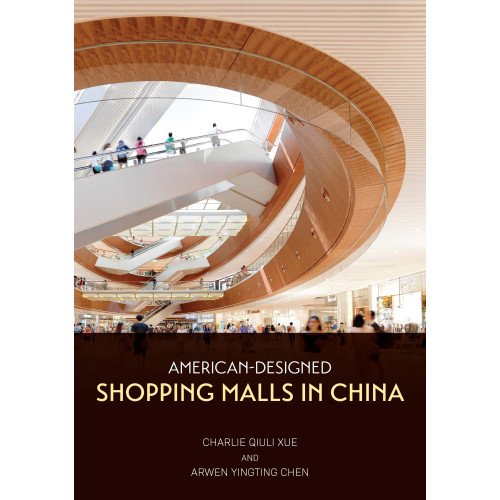
American-Designed Shopping Malls in China
(美式商場在中國)
ISBN : 978-988-8946-75-4
March 2026
332 pages, 7″ x 10″, 136 color illus. and 8 tables
- HK$480.00
Ebooks



China’s remarkable journey from poverty to becoming the world’s second-largest economic power is marked by extraordinary urban growth and consumption capacity of its urban population. Central to this development fervor are multifunctional commercial complexes and shopping malls, now key features of modern urban districts. The concept of shopping malls, originally introduced to China by American architects in the 1980s, has since flourished on an even larger scale than their American counterparts.
This book delves into the origins of shopping mall development in the United States after World War II, tracing how American architects exported this building type into China’s rapidly evolving urban landscapes, particularly in Beijing, Shanghai, Chengdu, Kunming, and Guangzhou. Using primary sources, statistical analyses, and illustrated case studies, the book explores the evolution of shopping malls as a consequence of China’s profound economic, social, and cultural change over the past four decades. The book also highlights the impact of American consumerism on the everyday lives of Chinese people, altering not only consumer patterns but also local architectural practices. This tale of transformation is essential reading for anyone interested in China’s rapid urban development.
“Food coupon rationing gave way to shopping mall construction as China’s economy surged. In this book, the authors explore the question of why American-designed shopping malls appeared in China since the inception of the Open Door Policy. This well-illustrated and thorough volume analyzes decades of mall construction and makes a solid contribution to an understudied topic. All in all, a thoroughly good read.”
—Peter G. Rowe, Raymond Garbe Professor of Architecture and Urban Design and Harvard University Distinguished Service Professor
“Charlie Xue has a distinguished pedigree in uncovering lesser-known areas of contemporary Chinese architecture. Here, the authors have written a fascinating book that traces how the shopping mall—a key emblem of postwar US consumerist capitalism—came to be adopted, and mutated, across China’s cities. Given global shifts, it will be interesting to see what future Chinese malls might become.”
—Murray Fraser, Professor of Architecture and Global Culture, The Bartlett School of Architecture, University College London