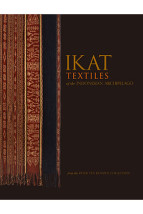
Ikat Textiles of Timor
Regional Variation and Hidden Asymmetry
ISBN : 978-988-74710-5-9
Distributed for HKU Museum and Art Gallery 香港大學美術博物館
January 2026
288 pages, 9.25″ x 12.2″, 310 color illus.
Not for sale in Indonesia
- HK$580.00
Ebooks


Ikat Textiles of Timor offers an in-depth overview of regional textile styles from both West and East Timor, while also contributing significant new insights into their design traditions. In academic literature, the ikated men’s wraps from Timor have long been described as symmetrical. However, Dr Peter ten Hoopen’s examination of early examples from museums and private collections reveals that, historically, two thirds of these textiles were actually asymmetrical. This discovery challenges an academic consensus that has persisted since 1912, and highlights a previously overlooked level of creative ingenuity—inviting greater admiration for the women who wove these complex designs.
Today’s ikat weavers on Timor, like many foreign scholars before them, seem unaware that asymmetry was once a dominant design principle. Many continue to assert that perfect symmetry has always been the tradition. Yet the historical textiles tell a different story. Ten Hoopen’s groundbreaking findings justify his focus on early specimens, which often display a greater degree of design sophistication than their contemporary counterparts.
It is striking that earlier researchers failed to recognise or report the prevalence of asymmetry in Timorese textiles. In early pieces, asymmetry is not only present but often dominant. This oversight reflects a broader pattern of neglect: textiles have historically been marginalised in Southeast Asian material culture studies, overshadowed by architecture, sculpture, weaponry, and jewellery. The author hopes that his historical investigations help correct this imbalance by demonstrating that these textiles embody far more artistic ingenuity, intellectual depth, and craftswomanship than previously acknowledged.